Quick answer
Package freeze-dried food as soon as it comes out of the machine, in an airtight, moisture-proof container with an oxygen absorber, and keep it somewhere cool, dark and dry. USDA’s Food Safety and Inspection Service (FSIS) says freeze-dried foods “must be packaged in moisture-proof, hermetically sealed containers.” For long-term storage, extension services point to heat-sealed mylar bags or #10 cans with oxygen absorbers. Glass jars work with an absorber or a vacuum seal, but they need a dark shelf.
How long the food then lasts is a separate question, covered in how long freeze-dried food lasts.
On this page
Quick Picks: Long-Term Freeze-Dried Storage Gear
Long-Term Pouches
7-Mil Mylar Bags — Thick light- and moisture-barrier pouches built for decades-long freeze-dried pantry storage.
Oxygen Removal
Food-Grade Oxygen Absorbers — Sized in 300 cc and 500 cc packets for quart bags, gallon pouches, and glass jars.
Airtight Heat Seam
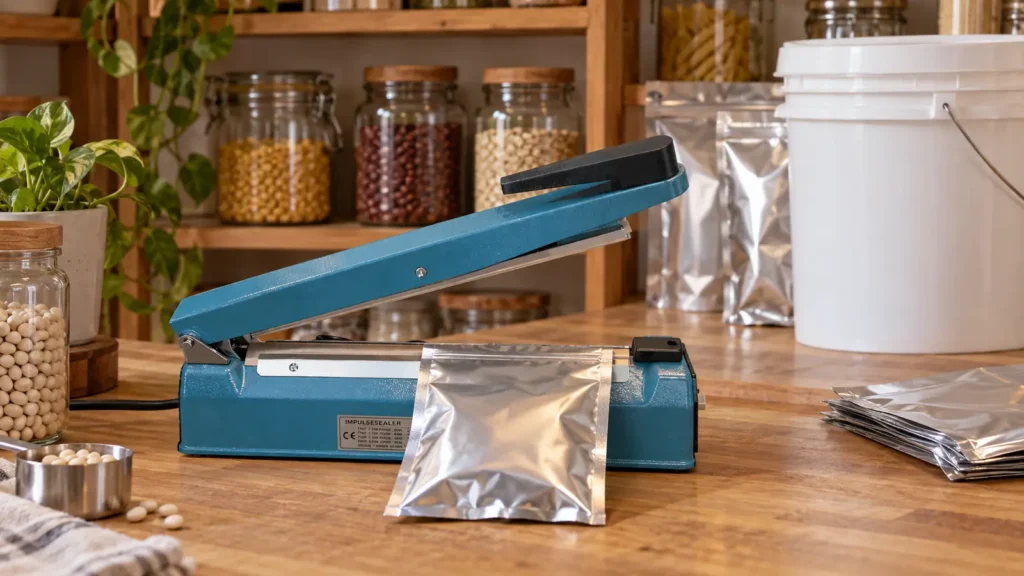
12-Inch Impulse Sealer — Delivers wide, uniform heat seals across thick laminated mylar pouches without curling.
Glass Jar Storage
Mason Jar Vacuum Sealer — Reseals everyday glass mason jars cleanly for short- and medium-term opened dry goods.
Calculate pouch and absorber counts per batch in our Freeze Dryer Batch Planner or check packet sizing in the Oxygen Absorber Size Chart (affiliate disclosure).
Why the container matters
Freeze-drying removes water, but it doesn’t make food sterile. UMN Extension notes that freeze-dried foods “absorb moisture easily,” and that “even the humidity in the home or kitchen can impact the freeze-dried food.” USU Extension says that if freeze-dried food is later exposed to moisture through damaged packaging or improper storage, its water activity can rise and bacteria can become active again. The container’s job is to keep out the three things that undo the work: moisture, oxygen and light, plus pests.
Containers compared
| Container | What extension says | Watch for |
|---|---|---|
| Mylar bag + absorber | Long-term; blocks light | Pests; heat-seal it |
| #10 can + absorber | Long-term; dark, pest-safe | Can sealer cost |
| Glass jar + absorber or vacuum | Medium to long-term | Light; store dark |
| Bucket (mylar inside) | Pest barrier for bags | Not a seal alone |
| Vacuum bag | About 2–3 years | Plastic lets air in |
| Zip-top bag or tub | A few months | Short-term only |
Sources for the table: University of Arizona Extension (AZ2097b), Penn State Extension, LSU AgCenter and UMN Extension, detailed below.
Mylar bags
Penn State Extension says mylar bags “block out air and light during storage but must be used with an oxygen absorber and heat-sealed with an impulse (heat) sealer,” and that they can be resealed once opened and take up less space than jars or cans. University of Arizona Extension says to add an oxygen absorber and remove as much air as possible before sealing, and that the longer you plan to store food, the thicker the bag should be. USU Extension’s 2026 guide recommends thick (5–7 mil) bags without clear windows. Arizona also says mylar bags “need to be placed in a food-safe tote or bucket to protect them from pests such as mice or insects.”
Shop mylar bags on Amazon → · Shop oxygen absorbers on Amazon → · Shop impulse sealers on Amazon →
To size absorbers for each bag, use our oxygen absorber size chart.
#10 cans
University of Arizona Extension lists #10 cans as long-term storage that is impenetrable by light and safe from pests. They need oxygen absorbers too. The catch is the equipment: Arizona notes a can sealer “may be quite costly.” Penn State adds that metal cans give airtight, dark storage, but all the food should be used as soon as possible once a can is opened.
Glass canning jars
Penn State Extension says glass canning jars work, and that for the longest shelf life you should put an oxygen absorber in the jar or remove the air with a vacuum sealer. Arizona agrees: canning jars with two-piece lids suit medium- or long-term storage when paired with an absorber or a vacuum sealer with a lid attachment. Arizona also warns that light breaks down fats, proteins and vitamins, so clear jars belong in a dark pantry, basement or cellar. LSU AgCenter is more cautious about plain jars, rating ordinary canning jars as short- to medium-term and vacuum-sealed jars as long-term. One advantage NCHFP points out for dried foods in general: in glass, “any moisture that collects on the inside can be seen easily.”
Shop jar vacuum sealers on Amazon →
Buckets and totes
A bucket isn’t the moisture barrier. The sealed bag inside it is. Arizona’s advice is to put mylar bags in a food-safe tote or bucket so mice and insects can’t chew through them. NCHFP likewise says dried foods should go into “clean, dry insect-proof containers.”
Shop 5-gallon buckets on Amazon →
Vacuum-sealer bags, zip-top bags and tubs
Penn State Extension rates vacuum-sealed plastic bags as midterm storage (about two to three years), “since water and oxygen can still pass through plastic bags,” and zip-top bags or food storage containers as short-term (a few months). UMN Extension cautions that some vacuum-sealer bags sold for sous vide or general storage “may not be the same as moisture barrier bags.” Arizona says airtight resealable jars or containers are fine without an absorber if you’ll eat the food within a month.
Packing it, step by step
- Check it’s dry first. Arizona Extension: crack one of the larger pieces in half. It should snap crisply and be dry in the middle. LSU AgCenter says dark spots in the middle of the product indicate moisture. If food has sat in a warm or humid room for more than 24 hours, LSU says to rerun a short drying cycle before packaging.
- Package right away. USU’s 2026 guide says to package immediately after drying in airtight, moisture-proof packaging.
- Add the right absorber. Size it to the container (size chart). Open only what you’ll use in one session, and keep the rest sealed. Shop oxygen absorber storage jars on Amazon →
- Seal it. Use an impulse sealer for mylar, two-piece lids with an absorber or vacuum attachment for jars, and a can sealer for #10 cans.
- Label it. UMN Extension says it is “best practice to label the container with the type of food, if the food is raw or cooked, and the date prepared.” Shop freezer labels on Amazon →
- Pack amounts you’ll use at once. NCHFP notes that each time a package is reopened, the food is exposed to air and moisture.
Where to keep it
- Cool, dark and dry. USU, LSU, Arizona and Penn State all say so. Penn State suggests “a basement, dark cupboard, pantry, or closet.”
- Temperature. University of Arizona Extension gives 32–75°F as the optimal storage temperature for freeze-dried foods, and says to keep containers away from heat sources. For shelf-stable foods in general, USDA FSIS says to never store them “above or beside the stove, under the sink, in a damp garage or basement,” and that temperatures below 85°F are best.
- Away from pests. Arizona says to keep mylar bags in a food-safe tote or bucket, and that #10 cans are safe from pests.
Checking stored food
NCHFP’s advice for dried foods: check them often during storage to see that they’re still dry. Foods affected by moisture but not spoiled should be used immediately or redried and repackaged, and moldy foods should be discarded. LSU AgCenter adds a limit: don’t redry food that has been sitting out in humid air for days, because “it could already be unsafe.”
After you open a container, reseal it or vacuum-seal it right away if you only used part of it (Arizona Extension).
What the freeze dryer makers say about packaging
Here’s what each manufacturer’s own manual or FAQ says:
- Harvest Right (FAQ): place the finished food “in vacuum-sealed containers that are moisture and oxygen proof (preferably a mylar pouch or a can).”
- Blue Alpine (FAQ): its machines ship with an impulse sealer, 50 mylar bags and 50 oxygen absorbers. It ties its 25+ year quality claim to proper storage in a high-quality mylar bag.
- Stay Fresh (5 & 7 Shelf user manual): when every tray is dry, “seal the food in airtight Mylar bags or mason jars right away.” The manual also warns that oil in fatty foods “can go rancid after the food is sealed in a Mylar bag.”
- Prep4Life, The Cube (Owner’s Manual V4-1; The Cube is no longer sold; its maker’s store is offline): package food immediately, using airtight containers (“mylar bags, vacuum bags, canning jars, etc.”) with an oxygen absorber. The manual also describes a Jar Seal cycle that seals glass jars in the chamber.
Manufacturer shelf-life figures are claims, not results checked on your food. Extension services are more cautious about home-dried food; see how long freeze-dried food lasts.
Special cases
- Candy: USU notes that high-sugar foods hold onto water and resist moisture loss during drying, so check that candy is fully dry before you package it. More in how to freeze-dry candy.
- Raw meat: freeze-drying doesn’t kill bacteria (UMN; USU). Label raw items clearly and cook them after rehydrating. See raw meat and eggs.
- Pet treats: see freeze-dried pet treats for what FDA and CDC say about raw pet food.
- Emergency supply: rotation and water planning are covered in freeze-dried food for emergency preparedness.
More gear by job: Best Freeze Dryer Accessories 2026: Mylar Bags, Oxygen Absorbers, Sealers & More. Food prep before storage: How to Freeze Dry Common Foods: Prep, Tray Loading, Foods to Avoid & Storage (2026).
FAQ
What is the best way to store freeze-dried food?
For long-term storage, extension services point to heat-sealed mylar bags or #10 cans with oxygen absorbers, kept cool, dark and dry (Arizona Extension; Penn State; LSU AgCenter). Glass jars with an absorber or a vacuum seal also work if they’re kept in the dark.
Can I store freeze-dried food in mason jars?
Yes. Penn State says to add an oxygen absorber or vacuum-seal the jar for the longest shelf life. Arizona says to keep clear jars in a dark place. LSU rates plain canning jars as short- to medium-term and vacuum-sealed jars as long-term.
Do I need oxygen absorbers?
For long-term storage, yes. Penn State says mylar “must be used with an oxygen absorber,” and Arizona pairs absorbers with jars and #10 cans. Arizona says short-term containers you’ll empty within a month don’t need one. Sizing: oxygen absorber size chart.
Is a 5-gallon bucket enough on its own?
Not according to the sources here. Arizona uses a food-safe tote or bucket to protect sealed mylar bags from pests. The sealed bag with an absorber is the moisture and oxygen barrier.
Can I store freeze-dried food in the garage?
USDA FSIS advises against storing shelf-stable foods in “a damp garage or basement” or anywhere with temperature extremes. University of Arizona Extension gives 32–75°F as the optimal range for freeze-dried foods.
Should I freeze freeze-dried food?
None of the sources above call for it. They focus on airtight, moisture-proof packaging kept cool, dark and dry.
Sources (checked October 26, 2026)
- USDA FSIS – Shelf-Stable Food Safety (last updated Oct 24, 2024): https://www.fsis.usda.gov/food-safety/safe-food-handling-and-preparation/food-safety-basics/shelf-stable-food
- NCHFP – Packaging and Storing Dried Foods: https://nchfp.uga.edu/how/dry/drying-general/packaging-and-storing-dried-foods/
- University of Arizona Cooperative Extension – Freeze Drying 101: Preparing and Storing Your Freeze Dried Products for Best Use (AZ2097b): https://extension.arizona.edu/sites/default/files/2025-03/az2097b-2025.pdf
- Penn State Extension – Let’s Preserve: Freeze-Drying: https://extension.psu.edu/lets-preserve-freeze-drying
- LSU AgCenter – Freeze-Drying at Home FAQ Sheet: https://www.lsuagcenter.com/topics/food_health/food/safety/consumer-food-safety/freeze-drying-at-home/faq-sheet
- UMN Extension – Preserving food at home: Freeze-drying: https://extension.umn.edu/food/preparing/cooking-home/food-preservation/freeze-drying
- USU Extension – Can I Freeze-Dry That? (Jan 2026): https://extension.usu.edu/foodsafety/research/can-i-freeze-dry-that-a-practical-guide-to-safe-and-effective-freeze-drying
- Harvest Right – FAQs: https://harvestright.com/pages/faqs
- Blue Alpine – FAQs: https://bluealpinefreezedryers.com/pages/faqs
- Stay Fresh – 5 & 7 Shelf User Manual (PDF): https://cdn.shopify.com/s/files/1/0602/5946/7415/files/StayFresh_Freeze_Dryer_5_and_7_Shelf_User_Manual.pdf
- Prep4Life – The Cube Owner’s Manual V4-1 (PDF): https://cdn.shopify.com/s/files/1/0726/5632/2858/files/Owners_Manual_V4-1.pdf