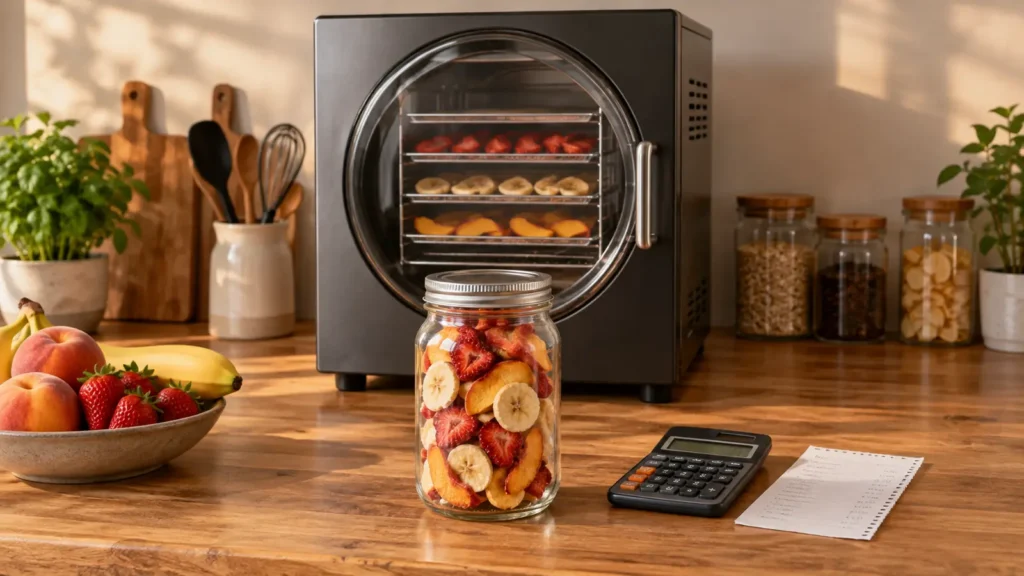
The short answer
Worth it if you’ll run it often and use what it makes. A few batches a year rarely pays off.
It’s usually worth it if you will:
- Run it regularly (think weekly, not a few times a year)
- Preserve food that would otherwise be wasted (garden surplus, bulk buys, leftovers)
- Replace food you would actually buy freeze-dried (backpacking meals, emergency storage, freeze-dried snacks)
It’s usually not worth it on money alone if you’d run a handful of batches a year or mainly preserve cheap staples you could store another way.
Manufacturers like to say a freeze dryer “pays for itself.” Harvest Right’s own energy article is more careful. It says a freeze dryer “doesn’t automatically save every household money” and suggests tracking food, electricity, packaging, and other costs against what you’d otherwise spend. That’s the approach we take here.
On this page
- Quick Picks: Compare Current Home Freeze Dryers
- Step 1: What does store-bought freeze-dried food cost?
- Step 2: What does a home batch cost?
- Step 3: Worked break-even example (ALL NUMBERS ARE EXAMPLES)
- Other value people cite (not all of it is cash)
- Costs people forget
- Who it’s worth it for
- Who should probably skip it (or rent first)
- If you decide it’s worth it
- FAQ
- Sources (checked October 11, 2026)
Quick Picks: Compare Current Home Freeze Dryers
Compact Starter Unit
Stay Fresh Small Freeze Dryer — Fits regular kitchen counters and standard household outlets for low-waste garden harvests.
Higher Batch Output
Stay Fresh Standard 5-Shelf — Popular mid-size steel unit built to handle full-family meal prep and bulk seasonal produce runs.
Pouch Cost Control
7-Mil Bulk Mylar Bags — Lower per-batch storage cost compared to small multi-packs when scaling weekly freeze-drying.
Batch Finishing
12-Inch Impulse Heat Sealer — Speeds up post-cycle bagging while protecting shelf life from moisture reabsorption.
Run your own kWh and grocery numbers in the Freeze-Drying Cost Calculator, match tray sizes with the Freeze Dryer Chooser, or compare store policies in Where to Buy a Harvest Right Freeze Dryer (affiliate disclosure).
Step 1: What does store-bought freeze-dried food cost?
Mountain House #10 cans on its website (October 22, 2026):
- Rice & Chicken #10: $54.49 for 9 servings ≈ $6.05/serving
- Chili Mac with Beef #10: $59.99 for 10 servings ≈ $6.00/serving
- Other #10 cans vary by meal; check current prices on the Mountain House site.
Both cans above showed sold out on Mountain House’s site on November 16, 2026; the prices are from October 22.
So prepared freeze-dried meals cost roughly $6+ per serving at retail.
Step 2: What does a home batch cost?
Use our method from Freeze Dryer Cost Per Batch: How to Calculate Electricity, Bags, Oil & Machine Cost (2026). That article’s labeled example (Harvest Right Medium, 12 lb fresh, 30-hour cycle at $0.1831/kWh, 10 bags) came to:
- Operating cost ≈ $13.02 per batch (electricity, bags, absorbers, oil). Example numbers; Blue Alpine’s own estimate is $4–$8 a load, and our example assumes more bags and a 30-hour cycle.
- Machine share ≈ $3.84 per batch ($1,995 ÷ 520 batches over 5 years, using the Harvest Right Medium’s $1,995–$2,795 sale range verified November 22, 2026). Example numbers.
On top of that you pay for the food itself, which isn’t free.
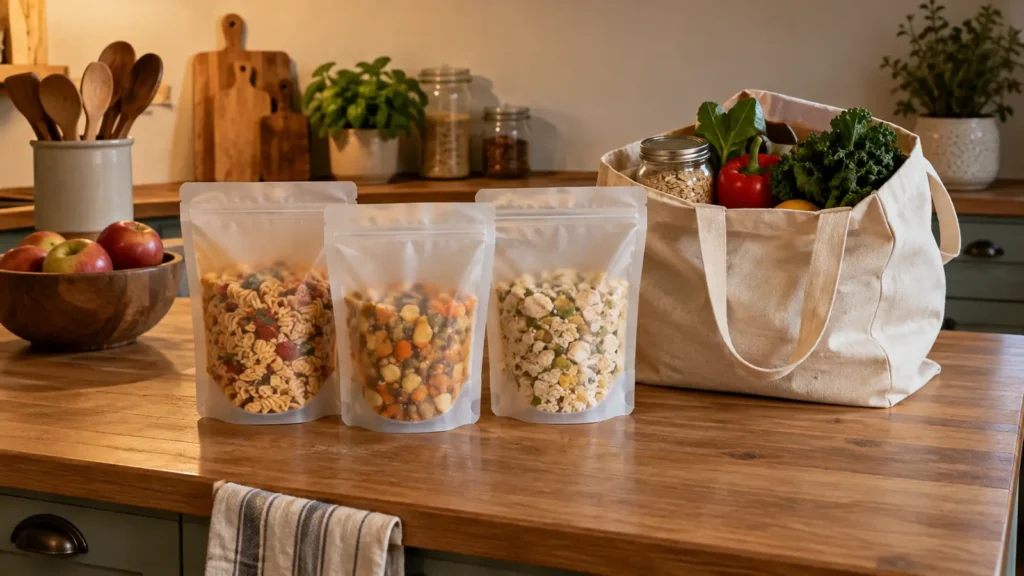
Step 3: Worked break-even example (ALL NUMBERS ARE EXAMPLES)
These are illustrative assumptions, not measurements or promises. Swap in your own. The cost and savings calculator lets you enter them for a new, refurbished or used machine and shows break-even.
Scenario: A household makes its own chili-mac-style meals to replace store-bought freeze-dried meals.
| Item | Example assumption | Per batch |
|---|---|---|
| Servings per batch | 12 lb fresh cooked meal → about 24 servings (assumes about 8 oz cooked per serving) | 24 servings |
| Food cost | $2.00 per serving homemade (example) | $48.00 |
| Operating cost | from the cost-per-batch example | $13.02 |
| Home cost per serving (excluding machine) | ($48.00 + $13.02) ÷ 24 | ≈ $2.54 |
| Store-bought equivalent | Mountain House #10 ≈ $6.00/serving (cited above) | $6.00 |
| Savings per serving | 6.00 − 2.54 | ≈ $3.46 |
| Savings per batch | 3.46 × 24 | ≈ $83 |
Break-even on the machine: $1,995 ÷ $83 ≈ 24 batches of meals you would otherwise have bought freeze-dried.
- At 1 batch/week → about 5½ months
- At 1 batch/month → about 2 years
- At 4 batches/year → about 6 years
Key caveat: This only counts if you’d actually have bought those $6 servings. If the realistic alternative is your regular freezer or pantry, savings shrink a lot. Your time (prep, packaging, defrost, maintenance) isn’t counted either.
Other value people cite (not all of it is cash)
From manufacturer guidance and extension resources:
- Reducing waste: preserving garden surplus or leftovers that would spoil (Harvest Right)
- Buying in season or on sale: berries at peak or meat on sale (Harvest Right)
- Custom diets: controlling ingredients in emergency or camping food
- Shelf-stable storage: properly packaged freeze-dried food is shelf-stable (UMN Extension, citing USDA). Manufacturers claim up to 25 years under ideal storage. Those claims assume complete drying and proper packaging. What extension services say: how long does freeze-dried food last?
Costs people forget
- A dedicated circuit: required for Harvest Right, 20A for some large models. Add electrician costs if you need a new circuit (get a local quote).
- A cart or table rated for the machine’s weight (about 90–260 lb for Harvest Right models) and at least 3 ft high, per Harvest Right’s drainage guidance
- Pump oil every 5–30 batches depending on brand, or a $1,495+ oil-free upgrade
- Mylar bags and oxygen absorbers for every batch
- Repairs outside warranty: Year‑1 coverage and years 2–3 of limited coverage vary by brand; check each brand’s current warranty terms for details on what is and isn’t covered. Blue Alpine describes vacuum pumps as consumables lasting about 3–5 years.
- Space and noise: about 65–75 dB per Blue Alpine, running roughly one to two days per batch depending on brand and load
Who it’s worth it for
- Gardeners and homesteaders with seasonal surplus
- Backpackers and campers replacing retail freeze-dried meals (about $6 a serving in #10 cans; pouches usually cost more)
- Families building emergency food storage who would otherwise buy #10 cans
- People with dietary restrictions who can’t find suitable commercial options
- Small side businesses, after checking cottage-food rules. Our freeze-dried candy sales checker covers what Michigan, Washington, Ohio and Pennsylvania agencies say about selling candy from home.
Who should probably skip it (or rent first)
- Occasional users (a few batches a year)
- People with no garage, basement, or utility space
- Anyone who can’t add a dedicated circuit
- Buyers who just want a few freeze-dried snacks. Buying those is cheaper.
Blue Alpine doesn’t offer official rentals, but its sister company lists one in Idaho, and Blue Alpine notes some owners rent their machines to local users. Where a local rental exists, renting or borrowing first is a low-risk way to find out whether you’ll keep using one.
If you decide it’s worth it
- Lowest-price pick: Harvest Right Countertop 360 (5–9 lb per batch; $1,295–$1,495 on sale by finish, November 22, 2026; In stock ($1,295 Black/Sage/Blue; Stainless $1,495 sold out)). Harvest Right Countertop 360 at harvestright.com → Waiting for a holiday sale? See what each freeze dryer brand has announced for Black Friday.
- Lowest price for 6–10 lb per batch: Stay Fresh Small ($1,750 sale, $2,190 regular, November 22, 2026; Available (pre-order); same 6–10 lb per batch as the HR Small, in a low countertop cabinet). Stay Fresh Small (Premier pump) →
- Same capacity with layaway and an oil-free option: Harvest Right Small ($1,795–$2,395 on sale by finish, November 22, 2026; Stainless $2,395 in stock; Black ($1,795) and Pale Blue ($1,895) sold out). Harvest Right Small at harvestright.com →
- Most tray area at mid-size: Stay Fresh 5-Shelf ($2,699–$3,299, sale to regular, November 22, 2026). Stay Fresh 5-Shelf (Premier pump) →
- Family pick: Harvest Right Medium ($1,995–$2,795 on sale by finish, November 22, 2026) or Blue Alpine Medium Select ($2,995–$3,095 by color, regular $3,095–$3,195, November 22, 2026). Harvest Right Medium at harvestright.com → Blue Alpine Medium Select →
Decided it’s worth it? Our home freeze dryer buyer’s guide compares every major brand by size, budget and pump type.
Or answer a few questions in the freeze dryer chooser, which matches your household, circuit, space and budget to published models.
Full picks: Best Home Freeze Dryers 2026: Picks by Budget, Household Size & Maintenance · Sizing: What Size Freeze Dryer Do I Need? How to Choose the Right Size and Model (2026)
FAQ
How long does it take a freeze dryer to pay for itself?
It depends entirely on how often you run it and what you’d otherwise buy. In our example, it took about 24 batches of meals replacing store-bought freeze-dried food. If you’re replacing cheaper alternatives, it takes far longer.
Is it cheaper to buy freeze-dried food?
For low volumes, yes. You avoid buying a machine that lists from $1,295 to $6,250 as of November 22, 2026 (Harvest Right Countertop 360 sale to Stay Fresh Mega regular). For regular, high-volume use replacing retail freeze-dried meals, home freeze-drying can cost less per serving.
Do freeze dryers hold resale value?
Used machines are commonly listed on local marketplaces, but we found no reliable resale-price data, so we can’t estimate resale value. Note that Harvest Right’s warranty does not transfer to a second owner.
Related: Still deciding between appliances? See freeze dryer vs dehydrator.
Sources (checked October 11, 2026)
- Harvest Right – How much electricity does a freeze dryer use?: https://harvestright.com/blogs/blog/how-much-energy-does-freeze-drying-use
- Harvest Right – Home freeze dryers, food production, warranty
- Harvest Right – Home freeze dryer product page (Medium sale price range used in the example, re-checked Oct 22, 2026): https://harvestright.com/products/home-pro-freeze-dryer-bundle
- Harvest Right – Countertop 360 product page (sale and regular prices, Oct 22, 2026): https://harvestright.com/products/countertop-freeze-dryer
- Stay Fresh – Mega (sale and regular price, Oct 22, 2026): https://stayfreshfreezedry.com/products/freeze-dryer-mega-freeze-dryer
- Mountain House – Rice & Chicken #10 (price and servings, re-checked Oct 22, 2026; sold out Nov 16, 2026): https://mountainhouse.com/products/rice-chicken-10-can
- Mountain House – Chili Mac with Beef #10 (price and servings, re-checked Oct 22, 2026; sold out Nov 16, 2026): https://mountainhouse.com/products/chili-mac-with-beef-10-can
- Mountain House – #10 cans collection: https://mountainhouse.com/collections/10-cans
- Blue Alpine – FAQs (rental, pump life, noise, operating cost): https://bluealpinefreezedryers.com/pages/faqs
- Stay Fresh – Collection: https://stayfreshfreezedry.com/collections/freeze-dryers
- UMN Extension – Freeze-drying: https://extension.umn.edu/food/preparing/cooking-at-home/food-preservation/freeze-drying
- Stay Fresh – Small Freeze Dryer, Premier Pump (sale and regular price, 6–10 lb per batch, 4 trays 7 × 15.5 in, 434 sq in, cabinet 26.7 × 18.5 × 17.3 in, 100 lb without pump, 36 lb pump, 7.2 CFM, 8 lb ice capacity, candy mode, “A regular 110V household outlet is required.”, included accessories; checked Oct 31, 2026): https://stayfreshfreezedry.com/products/small-freeze-dryer