Quick answer
Yes, you can freeze-dry leftovers if they were cooked and cooled safely. Load them within 3 to 4 days, and reheat to 165°F after rehydrating.
- RefrigerateWithin 2 hours of cooking
- Fridge limit3 to 4 days, or freeze them
- Works wellCooked meats, vegetables, starches
- Hard for home unitsVery fatty or sugary dishes
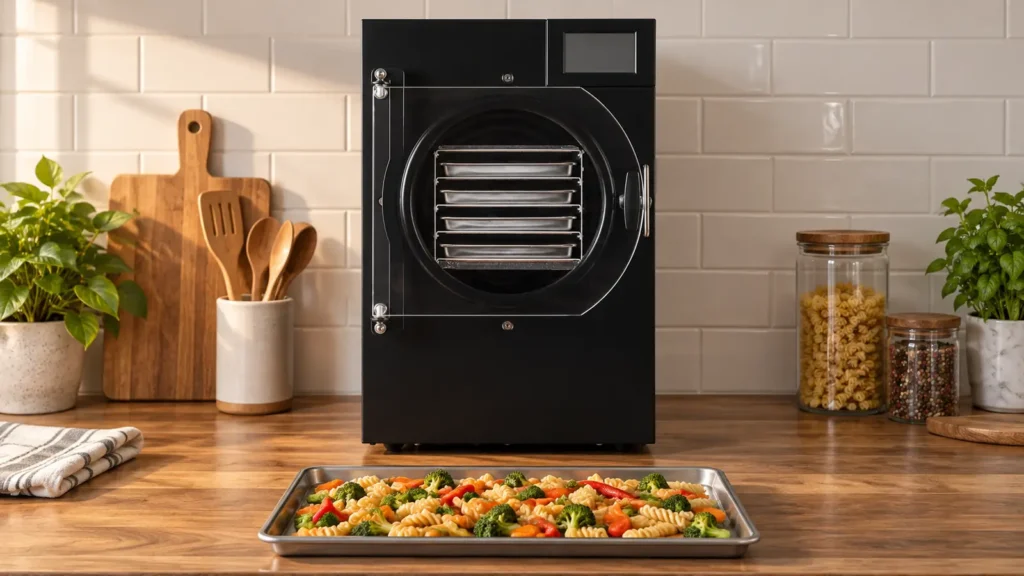
Leftovers and full meals can be freeze-dried at home. Penn State Extension lists “complete meals” among the foods you can freeze-dry (Penn State). The key safety point is that freeze-drying “does not kill illness-causing microorganisms” (UMN Extension). Whatever is on the food going in is still there coming out, so handle leftovers as carefully as you would before refrigerating them.
On this page
Step 1: Cook it safely
Cook meat and poultry to USDA safe minimum internal temperatures before they become leftovers. FSIS lists 145°F for raw beef, pork, lamb and veal steaks, chops and roasts (with at least a 3-minute rest), 160°F for ground meats and 165°F for all poultry (USDA FSIS).
The same temperatures apply to homemade freeze-dried pet treats. Utah State’s freeze-drying guide also says raw meat and poultry “must be fully cooked” before home freeze-drying (USU Extension).
Step 2: Cool and refrigerate fast
FSIS says leftovers must be refrigerated within 2 hours of cooking, and perishable food left at room temperature for more than 2 hours (1 hour above 90°F) should be thrown away. Divide large amounts into shallow containers so they cool quickly (USDA FSIS).
Step 3: Freeze-dry within the safe window
FSIS says leftovers keep 3 to 4 days in the refrigerator (USDA FSIS). Plan to load them well inside that window, not on day 4. If you can’t, freeze them and freeze-dry later. For timing, see how long freeze-drying takes. To plan several meals at once, the batch planner estimates per-tray loads, hours, and the bags and oxygen absorbers you’ll need.
What works and what doesn’t
- Works well: Utah State says “cooked meats, fruits, vegetables, and starches freeze-dry well” (USU Extension). Penn State gives directions for rehydrating full meals such as casseroles (Penn State).
- Fatty dishes: UMN says home units don’t work well for foods “high in fat” or high in sugar, or for baked goods (UMN Extension). For cooked ground beef, UMN says to “drain and thoroughly rinse with water to remove as much grease as possible” (UMN Extension).
- Sauces and gravies: Utah State says yes, “but emulsions may separate” (USU Extension).
- Thickness: Spread food in a single, even layer. Utah State cites extension guidance of about ¼ to ½ inch thick for most foods, and notes that thick foods such as casseroles can take more than 2 days to dry (USU Extension).
Step 4: Weigh before and after
UMN suggests weighing trays before and after freeze-drying. The weight lost is the moisture removed, which is “a good starting point for how much liquid to use when rehydrating” (UMN Extension). Write it on the label.
Shop kitchen scales on Amazon →
Step 5: Package and label
Package in moisture-proof, airtight containers. UMN says to label each container with the food, whether it’s raw or cooked, and the date (UMN Extension). For choosing a container, see freeze-dried food storage. For shelf life, see how long freeze-dried food lasts.
Shop mylar bags on Amazon → · Shop oxygen absorbers on Amazon →
Step 6: Rehydrate and reheat
- Penn State: rehydrate full meals such as casseroles “by mixing in water in 1/3 cup increments to reach the desired consistency,” then heat them in the oven or microwave (Penn State).
- Reheat leftovers to 165°F, measured with a food thermometer. Bring sauces, soups and gravies to a rolling boil (USDA FSIS).
- Treat rehydrated food like fresh food. UMN warns that microorganisms present before freeze-drying “may begin growing again” once water is added (UMN Extension).
Shop instant read thermometer on Amazon →
More on water amounts: how to rehydrate freeze-dried food. For trail meals, see DIY freeze-dried backpacking meals.
FAQ
Can I freeze-dry leftovers that have been in the fridge for a week? FSIS’s limit for refrigerated leftovers is 3 to 4 days (USDA FSIS). Freeze-drying won’t make older food safe.
Do I need to reheat after rehydrating? Yes, for cooked meals and leftovers. Reheat to 165°F (USDA FSIS).
Can I freeze-dry leftovers I’ve already frozen? Yes. FSIS says frozen leftovers stay safe indefinitely, though they lose moisture and flavor after 3 to 4 months. If you thaw them in the fridge first, use them within 3 to 4 days (USDA FSIS).
How thick should I spread leftovers on the tray? About ¼ to ½ inch for most foods, with meat pieces no thicker than about ¾ inch, per extension guidance cited by Utah State. For a big casserole, it suggests freezing it in small portions first (USU Extension).
Sources
- USDA FSIS: Leftovers and Food Safety: https://www.fsis.usda.gov/food-safety/safe-food-handling-and-preparation/food-safety-basics/leftovers-and-food-safety
- University of Minnesota Extension: Freeze-drying: https://extension.umn.edu/food/preparing/cooking-at-home/food-preservation/freeze-drying
- Penn State Extension: Let’s Preserve: Freeze Drying: https://extension.psu.edu/lets-preserve-freeze-drying
- Utah State University Extension: Can I Freeze Dry That?: https://extension.usu.edu/foodsafety/research/can-i-freeze-dry-that-a-practical-guide-to-safe-and-effective-freeze-drying