Quick answer
There’s no single figure for every batch. The cost depends on your machine, cycle length, electricity rate, and packaging.
- Add electricity, bags, oxygen absorbers, a share of pump oil, and a share of the machine. Food, labels, and other wear parts are optional extras.
- Electricity is the power you used times your rate. Measure a full batch for the most accurate figure.
- Packaging can cost more than electricity. The machine’s share looms larger when you run fewer batches. Plug your own numbers into the formula and worksheet below.
“How much does it cost to run a freeze dryer?” gets very different answers online, from “about $2 a batch” to “$8 a load.” Both can be right, because the answer depends on your machine, cycle length, power rate, and packaging. This guide gives you the formula so you can calculate your number, plus a fully labeled example. If you’d rather not do the math by hand, the freeze dryer cost and savings calculator works out cost per batch and per serving, savings per year compared with store-bought freeze-dried food, and break-even.
On this page
The formula
Cost per batch = Electricity + Packaging + Oxygen absorbers + Pump oil share + Machine cost share (+ optional: food, labels, other wear parts)
Then:
Cost per pound = Cost per batch ÷ pounds of fresh food in the batch
Harvest Right makes the same point on its energy page: looking at energy used per pound of food is more meaningful than the machine’s draw alone.
1. Electricity
The calculation
kWh used × your rate ($/kWh) = electricity cost
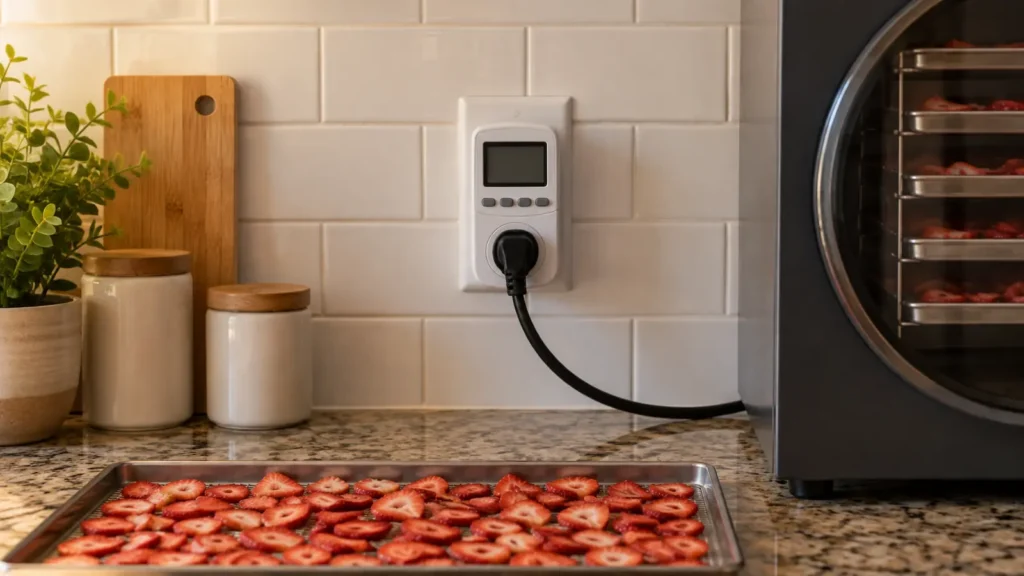
The most accurate kWh figure is one you measure. Harvest Right recommends using an energy monitor over a complete batch and logging the food, starting weight, duration, kWh, and rate. Shop plug-in energy monitors on Amazon → (Check that any monitor is rated for the machine’s amperage. A 20A machine needs a device rated for 20A.)
If you can’t measure yet: estimate from published draw
Average watts ÷ 1,000 × cycle hours = estimated kWh
Sizing a generator or battery for a batch? See running a freeze dryer on a generator or solar.
Published average draw figures:
| Model | Published average draw | Source |
|---|---|---|
| Harvest Right Small/Medium | 9–11 A, ~990–1,210 W | HR FAQ |
| Harvest Right Large | ~13 A, ~1,500 W | HR FAQ |
| Harvest Right X-Large | ~15 A, ~1,700 W | HR FAQ |
| Blue Alpine Medium | 9 A avg, 1,080 W avg (1,560 W max) | BA product page |
| Blue Alpine Large | 12 A avg, 1,440 W avg (2,040 W max) | BA product page |
| Stay Fresh | not published as average watts (Stay Fresh lists a dedicated 20 A circuit for the Large and Mega) | Stay Fresh product pages |
Published cycle times are 13–35 hr (Harvest Right, most foods), 12–20 hr average (Blue Alpine product page; its FAQ says about 26 hr), and 16–30 hr main drying for 8 lb (Stay Fresh 5/7-Shelf) or 20–40 hr for 20 lb (Stay Fresh Large/Mega).
Important caveat: The compressor, heaters, and pump do not pull steady peak wattage for the entire cycle, so average draw × cycle hours acts as a steady-wattage ceiling. During initial freezing, only the compressor draws power (~350–400 W), and tray heaters cycle intermittently during main drying; separately, Harvest Right publishes 11.5–17.5 kWh per batch specifically for its smaller 495 W Countertop 360. Harvest Right’s FAQ separately estimates $1.25–$2.80 per batch for Small/Medium, $2.00–$3.00 for Large, and about $4.00 for X-Large. Blue Alpine’s FAQ estimates $2–$3 of electricity per day. Those published per-batch estimates are lower than what the average-draw math produces, and Harvest Right’s energy article says a single dollar amount “isn’t very useful for everyone.” That’s the strongest argument for measuring your own machine with a plug-in or circuit-level energy meter.
2. Packaging (mylar bags)
Divide the pack price by the bag count to get the cost per bag, then multiply by the bags per batch. Bags per batch depends on portion size. For example, one 12 lb fresh batch of fruit might fill 6–12 one-quart-size bags depending on how you portion it.
As of October 22, 2026, many new Harvest Right, Blue Alpine, and Stay Fresh freeze dryers were sold with starter packs of mylar bags and oxygen absorbers (for example, 50 of each with several models; what’s included varies by model and retailer, so confirm it for the exact unit you buy). After that, see our Best Freeze Dryer Accessories 2026: Mylar Bags, Oxygen Absorbers, Sealers & More guide. Shop mylar bags on Amazon →
3. Oxygen absorbers
You need one absorber per bag, sized to the bag volume (follow the absorber maker’s cc chart). Cost = absorbers per batch × price per absorber. Absorbers lose capacity once exposed to air, and Harvest Right’s warranty terms specifically make the owner responsible for using fresh, unexpired absorbers. Shop oxygen absorbers on Amazon →
4. Pump oil share
(Cost of one oil change) ÷ (batches between changes)
- Harvest Right Premier pump: change every 20–30 batches, holds 2–3 cups. HR also includes a reusable oil filter.
- Harvest Right Standard (older) pump: change and filter every 4–5 batches
- Blue Alpine: about every 5–10 cycles (FAQ)
- Oil-free pumps (Harvest Right upgrade): no oil cost, but a higher upfront price (see Oil vs Oil-Free Freeze Dryer Pumps (2026): Cost, Maintenance & Which to Choose)
Harvest Right pump oil → · Shop vacuum pump oil on Amazon →
5. Machine cost share (amortization)
(Purchase price + pump upgrade + electrical work − expected resale) ÷ lifetime batches
Lifetime batches depends heavily on usage. Blue Alpine says its machines can last “more than a decade” with care and that vacuum pumps are consumables lasting about 3–5 years (8–10 with care). Those are manufacturer statements, not independent data. Use a conservative horizon, such as 5 years. To compare machines by size and brand before you buy, see the home freeze dryer buyer’s guide.
Worked example (ALL NUMBERS ARE EXAMPLES)
These are illustrative assumptions chosen to show the math. They are not measurements of any machine. Replace each line with your own numbers.
Machine: Harvest Right Medium at its November 22, 2026 Black/White sale price (Stainless costs more; used here as an example; check current price), ~1,100 W average (midpoint of HR’s 990–1,210 W range). Batch: 12 lb fresh strawberries (within HR’s 10–15 lb range), packed into 10 quart bags.
| Line item | Assumption (example) | Math | Cost |
|---|---|---|---|
| Electricity | 1,100 W avg × 30 hr cycle = 33 kWh; rate $0.1831/kWh (example rate, the same one used in our calculator; check your bill) | 33 × 0.1831 | $6.04 |
| Mylar bags | 10 bags × your cost per bag | 10 × your cost per bag | your packaging cost |
| Oxygen absorbers | 10 absorbers × your cost per absorber | 10 × your cost per absorber | your absorber cost |
| Pump oil | your cost per oil change ÷ 25 batches (Premier midpoint) | your oil-change cost ÷ 25 | your oil share |
| Operating subtotal | $6.04 electricity + your packaging, absorbers, and oil | ||
| Machine share | November 22, 2026 Black/White sale price ÷ 520 batches (2/week × 52 weeks × 5 years), no resale | sale price ÷ 520 | sale ÷ 520 |
| All-in per batch | operating subtotal + machine share | ||
| Per fresh pound | ÷ 12 lb | all-in ÷ 12 | all-in ÷ 12 lb |
What the example shows:
- Machine amortization is a real line item (sale price ÷ 520 batches in this example). Running more batches is the biggest lever on true cost.
- Packaging can cost more than electricity. Portioning into fewer, larger bags lowers the cost, but it also means opening more food at once.
- For comparison, Blue Alpine’s FAQ (checked October 11, 2026) estimates a “typical load” at about $4–$8 for electricity, bags, absorbers, and oil, which excludes the machine cost. Our electricity line alone is $6.04 with this 30-hour cycle; add your bag, absorber, and oil costs on top.
Is that worth it compared with buying freeze-dried food? See Is a Home Freeze Dryer Worth It? Honest Cost Math vs Store-Bought Freeze-Dried Food (2026).
Ways to lower cost per batch (without hurting quality)
- Run appropriately full batches within the manufacturer’s limit. Harvest Right warns that more food isn’t automatically more efficient if overloading interferes with proper freeze drying.
- Prep uniform, equal-sized pieces so drying finishes evenly (Penn State Extension, Harvest Right).
- Pre-freeze for workflow if you want, but remember your freezer uses power too (Harvest Right).
- Filter and reuse oil where the manufacturer allows it (Harvest Right includes a filter).
- Buy bags and absorbers in bulk, and store absorbers sealed.
- Check your utility’s time-of-use plan. Long cycles mean you can’t always avoid peak hours, but your rate structure affects the result, so check your own utility’s plan.
Troubleshooting: where it moved
Problems like vacuum errors, food that isn’t dry, cloudy pump oil, and slow defrost raise your cost per batch because they mean re-runs and wasted packaging. Our full step-by-step guide now lives at Freeze Dryer Troubleshooting: Vacuum Errors, Food Not Drying, Pump Oil & Defrost Problems. Routine care that prevents most issues is in Freeze Dryer Maintenance Schedule: Every Batch, Monthly & Yearly Checklist.
Quick pointers from Harvest Right’s published guidance:
- Confirm the door gasket seal and that the drain valve is fully closed before every batch.
- Change oil when it looks cloudy or dirty, even if you haven’t reached the interval yet.
- Defrost between every batch, and don’t use a hair dryer to speed it up.
FAQ
How much electricity does a freeze dryer use per batch?
No single number applies to every batch. Harvest Right publishes average draw (about 990–1,210 W for Small/Medium) and says actual use depends on model, food, load, cycle length, and room conditions. Measure a full batch with an energy monitor for an accurate figure.
Is it cheaper to run a larger freeze dryer?
Per pound, often yes, if you fill it. Larger machines draw more power but process more food per cycle. Harvest Right recommends comparing energy per pound, not just per machine.
What’s the biggest hidden cost?
For many households it’s the machine’s own amortized cost when batch counts are low, followed by packaging.
Does an oil-free pump save money?
It removes oil costs and oil-change time, but, as of October 22, 2026, Harvest Right listed the oil-free pump as a paid upgrade with a new freeze dryer (or sold on its own; check current pricing). Oil savings alone take a lot of batches to repay that upgrade. People usually buy oil-free pumps for convenience, not savings.
Sources (checked October 11, 2026)
- Harvest Right – How much electricity does a freeze dryer use?: https://harvestright.com/blogs/blog/how-much-energy-does-freeze-drying-use
- Harvest Right – FAQs (power draw, per-batch estimates, oil intervals, setup): https://harvestright.com/pages/faqs
- Harvest Right – Food production (model table): https://harvestright.com/pages/food-production
- Harvest Right – Home freeze dryer product page (Medium sale price range used in the example, re-checked Oct 22, 2026): https://harvestright.com/products/home-pro-freeze-dryer-bundle
- Harvest Right – Warranty (consumer responsibilities): https://harvestright.com/pages/warranty
- Harvest Right – Oil-free pump: https://harvestright.com/products/oil-free-pump
- Blue Alpine – FAQs (operating cost, oil interval, pump life): https://bluealpinefreezedryers.com/pages/faqs
- Blue Alpine – Medium Select (power draw, cycle time): https://bluealpinefreezedryers.com/products/medium-freeze-dryer
- Blue Alpine – Large Elite (power draw): https://bluealpinefreezedryers.com/products/large-freeze-dryer-elite
- Stay Fresh – 5-Shelf specs (drying time): https://stayfreshfreezedry.com/products/stay-fresh-freeze-dryer-with-industrial-pump
- Penn State Extension – Let’s Preserve: Freeze-Drying: https://extension.psu.edu/lets-preserve-freeze-drying