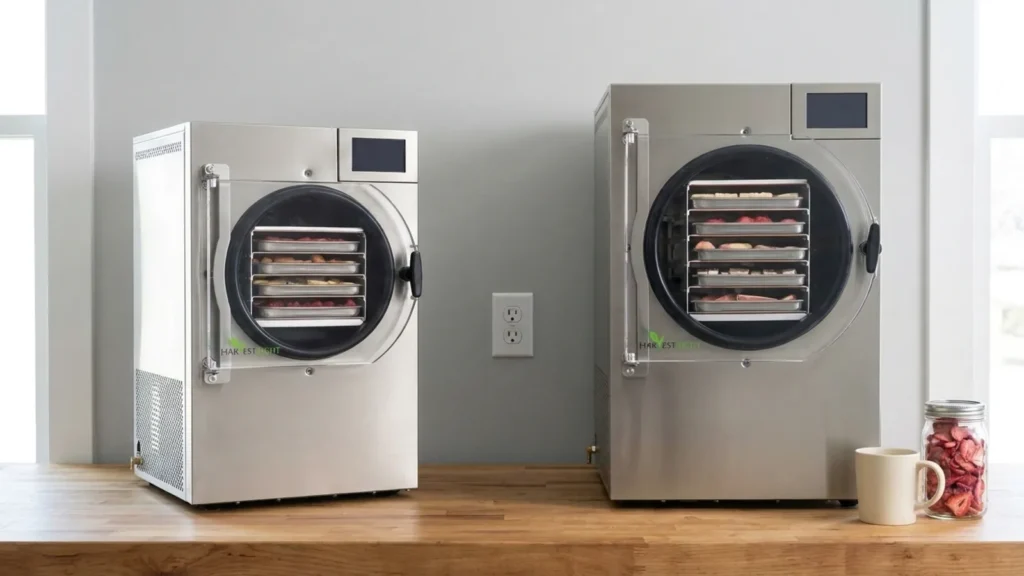
Buying the wrong size is one of the most expensive freeze-dryer mistakes. If the machine is too small, you’ll queue up food in the freezer for weeks. If it’s too big, you’ll pay more, need a bigger circuit, and give up a lot of floor space for capacity you rarely use. This guide gives you a simple way to size the machine first and choose the brand second.
On this page
- Step 1: Estimate pounds per week, not pounds per year
- Step 2: Match pounds per batch to a size class
- Step 3: Check your power before anything else
- Step 4: Measure your space, then add room
- Step 5: Think about noise
- Step 6: Set a realistic all-in budget
- Shortlist by household
- FAQ
- Sources (checked October 11, 2026)
Step 1: Estimate pounds per week, not pounds per year
Manufacturers love annual numbers. For example, Harvest Right says the Small can do up to 1,800 lb a year. Those figures assume four batches a week, 50 weeks a year (Harvest Right product page). Most households don’t run that schedule.
A better method:
- Pick your busiest month (garden harvest, bulk meat purchase, holiday leftovers).
- Estimate the pounds of fresh food you’d want to process that month.
- Divide by the batches you can realistically run. Most cycles take about 13–35 hours (Harvest Right’s published range), plus defrost and cleanup. For most people, 2–3 batches a week is realistic. Blue Alpine publishes shorter 12–20 hour averages, which could allow more batches.
Example (illustrative numbers): You want to preserve 60 lb of tomatoes, peppers, and berries in August and can run 3 batches a week, which is about 12 batches in a month. That’s 60 ÷ 12 = 5 lb per batch, so a Small-class machine (6–10 lb) would cover it. If your number is 120 lb, you need ~10 lb per batch. That’s the top of the Small range, so a Medium gives you headroom.
Step 2: Match pounds per batch to a size class
| Size class | Fresh food / batch | Example models (Oct 2026 price) | Typical fit |
|---|---|---|---|
| Small | 6–10 lb | Harvest Right Small ($2,395–$2,695 sale to regular for in-stock Stainless as of Nov 22, 2026; Black $1,795 and Pale Blue $1,895 sold out); smaller still: Harvest Right Countertop 360, 5–9 lb ($1,295–$1,595 sale to regular for in-stock Black/Sage/Pale Blue; Stainless sold out); Stay Fresh Small, 6–10 lb ($1,750–$2,190, sale to regular) | 1–2 people, snacks, leftovers, light gardening |
| Medium | 10–18 lb | Harvest Right Medium ($1,995–$2,795 sale by finish, Nov 22, 2026), Blue Alpine Medium Select ($2,995–$3,095, sale to regular), Stay Fresh 5-Shelf ($2,699–$3,299, sale to regular) | 3–5 people, regular meal prep, moderate garden |
| Large | 16–35 lb | Harvest Right Large ($2,995–$3,395 sale by finish), Blue Alpine Large Select/Elite ($3,995–$4,095 / $4,595–$4,795, sale to regular), Stay Fresh Large ($4,335–$4,950, sale to regular), all Oct 22, 2026 | Big families, homesteads, bulk buying |
| X-Large / Mega | 40–50 lb | Harvest Right X-Large ($4,495–$5,295, sale to regular, Nov 22, 2026), Stay Fresh Mega ($5,355–$6,250, sale to regular) | Small business, very large harvests |
We compare every major home freeze-dryer brand. Some links earn us a commission, and no brand pays for placement.
Blue Alpine’s own FAQ suggests that a Medium “should fill your needs perfectly” for a family of five that is just starting out. Treat that as a rule of thumb, not a guarantee.
Harvest Right Countertop 360 at harvestright.com → · Harvest Right Small at harvestright.com → · Stay Fresh Small (Premier pump) → · Harvest Right Medium at harvestright.com → · Stay Fresh 5-Shelf (Premier pump) → · Blue Alpine Medium Select →
Tray space beats tray count
Food must go on in a single thin layer, so square inches decide how much food fits. For comparison:
- Harvest Right Small 434 sq in · Medium 675 · Large 1,107 · X-Large 2,251
- Stay Fresh 5-Shelf 800 · 7-Shelf 1,120 · Large 1,283 · Mega 1,733
- Blue Alpine Medium ≈585 (5 × 9×13 in, calculated) · Large ≈1,170 (5 × 13×18 in, calculated)
- Prep4Life’s The Cube (Select or Elite; discontinued) 5-Shelf 832.5 · 4-Shelf with extension rack 1,332 (9.25 × 18 in trays, per Prep4Life’s 4-Shelf vs 5-Shelf table, checked October 24, 2026)
The Cube is no longer sold; its maker’s store is offline. It isn’t placed in a size class above because Prep4Life didn’t publish a pounds-per-batch figure on the pages we checked. When last listed, the Cube Select was $2,995–$3,295 on sale ($3,395–$3,695 regular) and the Cube Elite was $4,595–$4,895 on sale ($5,195–$5,595 regular), by finish and shelf setup. For a machine you can shop now, use the size classes and models above.
Light, bulky foods like herbs, greens, and candy use up tray area. Dense, wet foods like soups and fruit use up ice capacity first. Stay Fresh, for example, warns that its 7-Shelf (the same ice capacity as the 5-Shelf despite two more trays: 14 lb on Stay Fresh’s specifications page, 12 lb on its product pages) can be overwhelmed by wet, dense loads.
Step 3: Check your power before anything else
| Requirement | Models |
|---|---|
| Standard 110–120V outlet, 15A | Blue Alpine Medium |
| 110V, dedicated 15A circuit | Harvest Right Small, Medium, Large (NEMA 5-15) |
| Dedicated 15/20A recommended | Stay Fresh 5-Shelf & 7-Shelf |
| 20A receptacle / circuit | Harvest Right X-Large (NEMA 5-20), Blue Alpine Large, Stay Fresh Large and Mega (dedicated 20A, NEMA 5-20) |
| 240V, 30A | Blue Alpine XL |
| 3-prong 15 or 20A outlet, 115VAC; plug in directly, no extension cord | The Cube Select and Elite (discontinued; Prep4Life owner’s manual, checked October 24, 2026) |
Harvest Right’s warranty excludes extension-cord use. If you’d need a new circuit, get an electrician’s quote before choosing a Large or X-Large. To see how your circuit, space and budget narrow the field, try the freeze dryer chooser, which suggests a size class and a few models that fit.
Step 4: Measure your space, then add room
| Model | Exterior W × D × H | Weight |
|---|---|---|
| Harvest Right Small | 17.4 × 21.5 × 26.8 in | 91 lb |
| Harvest Right Medium | 19 × 25 × 29 in | 119 lb |
| Harvest Right Large | 21.3 × 27.5 × 31.3 in | 143 lb |
| Harvest Right X-Large | 24.3 × 37.4 × 35.6 in | 258 lb |
| Blue Alpine Medium | 20 × 21 × 30 in | 110 lb (with pump) |
| Blue Alpine Large | 24 × 25.5 × 34 in | 130 lb (with pump) |
| Stay Fresh 5/7-Shelf | 20 × 26 × 31 in | 165/170 lb (no pump) |
| Stay Fresh Large | 22 × 29 × 34.5 in | 224 lb (no pump) |
| Stay Fresh Mega | 25.25 × 33.5 × 37.5 in | 268 lb (no pump) |
Then add:
- Pump space next to the machine. Every model here uses an external pump.
- Door swing in front.
- Ventilation: at least 6 in per side (Blue Alpine), and don’t box the unit into a corner or cabinet (Harvest Right).
- Height: Harvest Right recommends a stable surface high enough that the drain hose can drop down into a bucket or floor drain.
- Room temperature: Harvest Right says 50–75°F is ideal and that its warranty requires operation between 35°F and 95°F.
Need a cart or table rated for the weight? See Best Freeze Dryer Accessories 2026: Mylar Bags, Oxygen Absorbers, Sealers & More.
Step 5: Think about noise
Blue Alpine publishes 65–75 dB for its machines (“comparable to a washing machine”) and says most owners keep them in a garage, mudroom, or basement. Because a cycle runs for about a day, you’ll want a space where that steady noise doesn’t matter. Oil-free pumps are often marketed as quieter (Harvest Right calls its oil-free pump “quiet”), but Harvest Right and Stay Fresh don’t publish complete-unit dB figures for home models on the pages we checked.
Step 6: Set a realistic all-in budget
Add up:
- Machine price (above)
- Optional oil-free pump: +$1,495 at purchase, or $1,695 on its own (Harvest Right, Oct 22, 2026)
- Electrical work, if needed (get a local electrician’s quote)
- Cart or table
- First-year consumables: mylar bags, oxygen absorbers, oil
Then see whether the volume justifies it in Is a Home Freeze Dryer Worth It? Honest Cost Math vs Store-Bought Freeze-Dried Food (2026) and Freeze Dryer Cost Per Batch: How to Calculate Electricity, Bags, Oil & Machine Cost (2026).
Shortlist by household
- 1–2 people, apartment or small home: Harvest Right Small (small footprint, 110V, oil-free pump option). Harvest Right Small at harvestright.com → Or, for a lower cabinet (17.3 in tall vs about 27 in) at a lower sale price ($1,750 vs $2,395 for in-stock Harvest Right Small Stainless on Nov 22, 2026; lower-priced finishes sold out), Stay Fresh’s Small (same 6–10 lb per batch, 110V). Stay Fresh Small (Premier pump) → Stay Fresh’s other sizes are compared in Stay Fresh freeze dryer sizes.
- Family of 3–5: Stay Fresh 5-Shelf (offers a lot of tray space for the price), Harvest Right Medium (oil-free pump option), or Blue Alpine Medium Select (faster published cycles). Stay Fresh 5-Shelf (Premier pump) → Harvest Right Medium at harvestright.com → Blue Alpine Medium Select →
- Big garden or bulk buyer: Harvest Right Large (15A), Stay Fresh Large (20A), or Blue Alpine Large (20A). Harvest Right Large at harvestright.com → Stay Fresh Large → Blue Alpine Large Select →
- Side business or very high volume: Harvest Right X-Large or Stay Fresh Mega. Check your state’s cottage-food laws first. For Michigan, Washington, Ohio and Pennsylvania, our freeze-dried candy sales checker summarizes what each state agency allows. Harvest Right X-Large at harvestright.com → Stay Fresh Mega →
Full brand comparison: Home Freeze Dryer Buyer’s Guide 2026: Every Major Brand
FAQ
Is a small freeze dryer big enough for a family of four?
It can be if you mostly preserve snacks and leftovers. If you’re preserving harvests or full meals, most families find a Medium-class machine (10–18 lb) more practical. Use the pounds-per-week method above.
Is it better to buy bigger than I need?
Not automatically. Bigger machines cost more, may need a 20A circuit, and take more space. Harvest Right notes that smaller batches give more consistent results and are easier on the machine, while overloading extends batch times.
Can I run two smaller machines instead of one large one?
Yes, and it gives you a backup if one machine is down, but each machine needs its own dedicated circuit (Harvest Right).
Does the 7-Shelf Stay Fresh hold more than the 5-Shelf?
It has more tray area (1,120 vs 800 sq in), but both models share the same ice capacity (14 lb on Stay Fresh’s specifications page; its product pages say 12 lb) and the same “up to 18 lb” of food per batch. The extra trays help with light, bulky foods; for dense, wet loads the 7-Shelf doesn’t hold more.
Related: Before you order, check the space, outlet and noise requirements by model.
Sources (checked October 11, 2026)
The Cube is no longer sold. Its maker’s store (p4lfood.com) was a parked page when read November 21, 2026.
- Harvest Right – What size freeze dryer do I need: https://harvestright.com/blogs/blog/what-size-freeze-dryer-do-i-need
- Harvest Right – Home freeze dryers: https://harvestright.com/pages/home-freeze-dryers
- Harvest Right – Food production: https://harvestright.com/pages/food-production
- Harvest Right – Home freeze dryer product page (sale and regular prices, re-checked Oct 22, 2026): https://harvestright.com/products/home-pro-freeze-dryer-bundle
- Harvest Right – Countertop 360 product page (sale and regular prices by finish, Oct 22, 2026): https://harvestright.com/products/countertop-freeze-dryer
- Harvest Right – FAQs (batch sizes, including the Countertop 360’s 5–9 lb): https://harvestright.com/pages/faqs
- Harvest Right – Warranty: https://harvestright.com/pages/warranty
- Harvest Right – Oil-free pump: https://harvestright.com/products/oil-free-pump
- Blue Alpine – Medium Select: https://bluealpinefreezedryers.com/products/medium-freeze-dryer
- Blue Alpine – Large Elite: https://bluealpinefreezedryers.com/products/large-freeze-dryer-elite
- Blue Alpine – FAQs: https://bluealpinefreezedryers.com/pages/faqs
- Blue Alpine – XL: https://bluealpinefreezedryers.com/products/xl-freeze-dryer-50-down-reservation-fee
- Stay Fresh – Collection: https://stayfreshfreezedry.com/collections/freeze-dryers
- Stay Fresh – 5-Shelf: https://stayfreshfreezedry.com/products/stay-fresh-freeze-dryer-with-industrial-pump
- Stay Fresh – 7-Shelf: https://stayfreshfreezedry.com/products/stay-fresh-7-shelf-freeze-dryer-with-industrial-pump
- Stay Fresh – Which to buy (older): https://stayfreshfreezedry.com/blogs/learn-about-freeze-drying/which-freeze-dryer-should-i-buy
- Stay Fresh – Large: https://stayfreshfreezedry.com/products/large-freeze-dryer
- Stay Fresh – Mega: https://stayfreshfreezedry.com/products/freeze-dryer-mega-freeze-dryer
- Blue Alpine – Large Select: https://bluealpinefreezedryers.com/products/large-freeze-dryer
- Prep4Life – The Cube collection page (checked October 24, 2026)
- Prep4Life – The Cube Select product page (prices, 4-Shelf vs 5-Shelf table; checked October 24, 2026)
- Prep4Life – The Cube Elite product page (prices; checked October 24, 2026)
- Prep4Life – Owner’s Manual V4-1 (power requirements; checked October 24, 2026): https://cdn.shopify.com/s/files/1/0726/5632/2858/files/Owners_Manual_V4-1.pdf
- Stay Fresh – Small Freeze Dryer, Premier Pump (sale and regular price, 6–10 lb per batch, 4 trays 7 × 15.5 in, 434 sq in, cabinet 26.7 × 18.5 × 17.3 in, 100 lb without pump, 36 lb pump, 7.2 CFM, 8 lb ice capacity, candy mode, “A regular 110V household outlet is required.”, included accessories; checked Oct 31, 2026): https://stayfreshfreezedry.com/products/small-freeze-dryer
- Stay Fresh – Freeze dryers collection (Small: “a dedicated 15 amp circuit is recommended on the Small”; Small trays “for which mesh, dividers and parchment are not made”; checked Oct 31, 2026): https://stayfreshfreezedry.com/collections/freeze-dryers