Quick answer
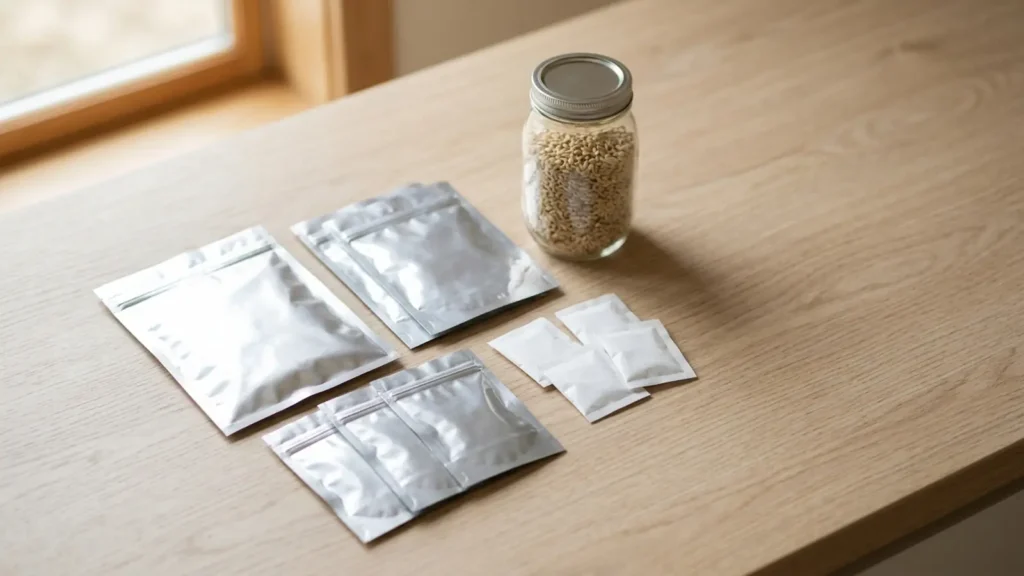
University of Arizona Cooperative Extension’s freeze-drying guide (February 2025) recommends 100 cc for a 1-quart container, one 300 cc absorber for 1 gallon, two 500 cc or one 1,000 cc for 2 gallons, and three 1,000 cc absorbers for 5 gallons. An older Utah State University Extension fact sheet (2011) gives smaller amounts for quarts and 5-gallon containers. Both size by container volume, not by food weight. Whatever you use, the food has to be completely dry, and you need to seal the bag within minutes of opening the absorber pack.
On this page
Quick Picks: Mylar Bags, Absorbers & Sealing Gear
Multi-Pack Sizing
Food-Grade Oxygen Absorbers (300 cc & 500 cc) — Fits quart, gallon, and bucket volumes cleanly so individual packets match each harvest batch.
Light & Moisture Barrier
7-Mil Stand-Up Mylar Bags — Thick laminated foil pouches protect dry freeze-dried produce, meats, and meals for decades.
Spare Pack Storage
Airtight Mason Jars for Leftover Absorbers — Seals opened absorber packets immediately after packing so remaining iron powder stays active.
Airtight Seams
12-Inch Impulse Heat Sealer — Fuses thick 7-mil mylar tops cleanly to prevent slow pinhole leaks over long-term pantry storage.
Calculate total pouches and absorber counts per run in our Freeze Dryer Batch Planner (affiliate disclosure).
Oxygen absorber size chart
| Container | University of Arizona Extension (2025) | Utah State University Extension (2011) |
|---|---|---|
| 1 quart | 100 cc | One 50 cc |
| 1 gallon (bag or jar) | One 300 cc | 300 cc |
| #10 can | Not listed | 300 cc |
| 2 gallons | Two 500 cc, or one 1,000 cc | Not listed |
| 5 gallons | Three 1,000 cc (3,000 cc total) | Three 500 cc (1,500 cc total) |
The two charts agree on 1 gallon but differ on quarts and 5-gallon containers. Arizona’s figures are the newer of the two and come from a series written for home freeze drying. They’re also the larger amounts, so following them leaves you on the generous side of both charts. For sizes that aren’t listed, such as a 1-pint pouch or a 2.5-gallon bag, neither publication gives a figure, so round up to the next container size listed above.
Sellers publish their own charts, and they don’t always match either one. As of November 2026, Discount Mylar Bags’ Oxyfree absorber page lists one 300 cc absorber for a 1-quart to 1-gallon bag, two 300 cc for a 2-gallon bag, and one 2,000 cc (or seven 300 cc) for a 5-gallon bag or bucket. Its 5-gallon figure sits between the USU and Arizona amounts, and its quart figure is larger than both. If your supplier’s chart and the extension charts differ, using the larger amount keeps you on the generous side.
Shop oxygen absorbers on Amazon →
What “cc” means on an absorber
USU Extension explains that absorbers are small packets of iron powder and salt. Moisture in the food and air lets the iron rust, which takes oxygen out of the sealed container. The “cc” rating is the packet’s oxygen-absorbing capacity in cubic centimeters. Packets range from 20 cc to 2,000 cc. USU says the goal is to bring the oxygen in the container down to 0.01% or less, and that “this is achieved through the number of packets and the size of the container.”
So the container size, not the weight of the food inside, sets the absorber size. Both charts work on that basis.
Which containers need absorbers
Arizona Extension’s guide sorts storage by how long you’ll keep the food:
- Airtight resealable jars or containers (short-term): fine if you’ll eat the food within a month. No oxygen absorber is needed.
- Canning jars with two-piece lids (medium or long-term): use them with an oxygen absorber or a vacuum sealer with a lid attachment. Clear jars let light in, and light breaks down fats, proteins and vitamins, so store them somewhere dark.
- Mylar bags (long-term): light can’t get through them. Add an oxygen absorber, push out as much air as you can, and seal with an impulse sealer.
- #10 cans (long-term): these block light and pests, but you need a can sealer, which can be costly, and you still need oxygen absorbers.
USU adds that absorbers also work with foil pouches, PETE plastic bottles and glass canning jars. Oxygen slowly passes through ordinary plastic over time, and lining PETE buckets with mylar cuts down that oxygen exchange.
Shop mylar bags on Amazon → · Shop impulse sealers on Amazon →
Step by step: packing a mylar bag
- Check that the food is fully dry. Arizona Extension says to crack one of the larger pieces in half. It should snap crisply and be dry in the middle. If you feel coldness or moisture, the whole batch goes back in the freeze dryer for a few more hours.
- Fill the bags first. Have every bag filled and lined up before you open the absorber pack.
- Add the right absorber size for the bag’s volume (see the chart above).
- Press out as much air as you can and seal with an impulse sealer, as Arizona recommends.
- Reseal the leftover absorbers right away (see the next section).
- Put sealed bags in a food-safe bucket or tote. Arizona says this protects them from mice and insects, and USU notes that rodents can chew through mylar.
- Label and store cool, dark and dry. Arizona gives 32–75°F as the optimal storage range for freeze-dried food, away from furnaces and stoves.
Plan the packaging for a batch: The batch planner estimates trays, batches and packaging for the amount of food you want to put up.
Handling and storing absorbers
From USU Extension’s fact sheet:
- Work fast. Once the package is open, an absorber’s shelf life is very short. Use it within 15 minutes.
- Store the leftovers airtight. Keep unused packets in an airtight glass jar or PETE container for up to 6 months.
- Unopened packs last from 6 months to about a year.
- Check freshness. A fresh absorber has pink or gray powder inside. A spent one is brown and clumped.
- Don’t reuse them, and don’t eat them. Absorbers aren’t harmful, but throw them away when you open your stored food.
Shop oxygen absorber storage jars on Amazon →
Safety: dry food only
USU says foods should be below 10% moisture for storage with absorbers, and warns that “storing foods with high moisture content in reduced oxygen packaging may result in botulism poisoning.” Its packaging guidance makes the same point about vacuum packaging: removing oxygen can increase the ability of botulism bacteria to grow, and it isn’t a preservation method by itself.
That’s why the dryness check in step 1 matters. An absorber removes oxygen. It doesn’t remove water, and it doesn’t make under-dried food safe. More on spotting a finished batch: freeze dryer troubleshooting.
Buckets and bulk storage
For 5-gallon buckets, the two charts differ the most: three 1,000 cc absorbers (Arizona) or three 500 cc (USU). Another option is several smaller sealed mylar bags inside one bucket, each with an absorber sized for that bag. Arizona’s guide describes the bucket as pest protection for the bags inside, and this way opening one bag doesn’t expose the rest.
Shop 5-gallon buckets on Amazon →
FAQ
How many oxygen absorbers for a 1-gallon mylar bag?
One 300 cc absorber. Arizona and USU Extension agree on this one.
How many oxygen absorbers for a 5-gallon bucket?
Arizona Extension (2025) says three 1,000 cc absorbers. USU Extension (2011) says three 500 cc. Arizona’s is the newer, freeze-drying-specific figure and the larger of the two.
Do I need oxygen absorbers for freeze-dried candy?
For long-term storage in mylar, Arizona’s guide recommends an absorber with the food. For a jar you’ll finish within a month, it says no absorber is needed. If you plan to sell candy, check your state’s packaging rules first. Ohio’s cottage food rule, for example, says cottage food products “may not be packed using reduced oxygen packaging.” Our freeze-dried candy sales checker flags this packaging question for Ohio and also covers Michigan, Washington and Pennsylvania. More: selling freeze-dried candy.
Can you reuse oxygen absorbers?
No. USU says to discard them when you open your stored food. A spent absorber is brown and clumped.
How long does food last with oxygen absorbers?
That depends on the food, the packaging and the storage temperature. See how long freeze-dried food lasts.
Related: best freeze dryer accessories · freeze-dried food for emergency preparedness · how to make freeze-dried candy
Shopping list: Shop oxygen absorbers on Amazon → · Discount Mylar Bags Oxyfree absorbers (300 cc) · Shop mylar bags on Amazon → · Shop impulse sealers on Amazon → · Shop oxygen absorber storage jars on Amazon →
Sources (checked October 21, 2026)
- University of Arizona Cooperative Extension – az2097b, Freeze Drying 101: Preparing and Storing Your Freeze Dried Products for Best Use (February 2025; absorber table by container size, storage containers, dryness check, 32–75°F storage): https://extension.arizona.edu/sites/default/files/2025-03/az2097b-2025.pdf
- Utah State University Extension – Oxygen Absorbers, FN/Food Preservation/2011-01pr (cc sizes, quart/gallon/#10 can/5-gallon amounts, below 10% moisture, botulism warning, 15-minute use, storage of unused packets): https://digitalcommons.usu.edu/cgi/viewcontent.cgi?article=1196&context=extension_curall
- Ohio Administrative Code 901:3-20-04 (cottage food products may not be packed using reduced oxygen packaging): https://codes.ohio.gov/ohio-administrative-code/rule-901:3-20-04
- Utah State University Extension – Packaging Foods (foil/mylar pouches, rodents, PETE bottles with absorbers, vacuum packaging and botulism): https://extension.usu.edu/preserve-the-harvest/food-storage-packaging
- Discount Mylar Bags – OxyFree Oxygen Absorbers, 300cc & 2000cc Packs (seller’s sizing table by container; checked November 1, 2026): https://discountmylarbags.com/oxyfree-oxygen-absorbers-300cc-2000cc-packs-high-capacity-food-grade-storage/