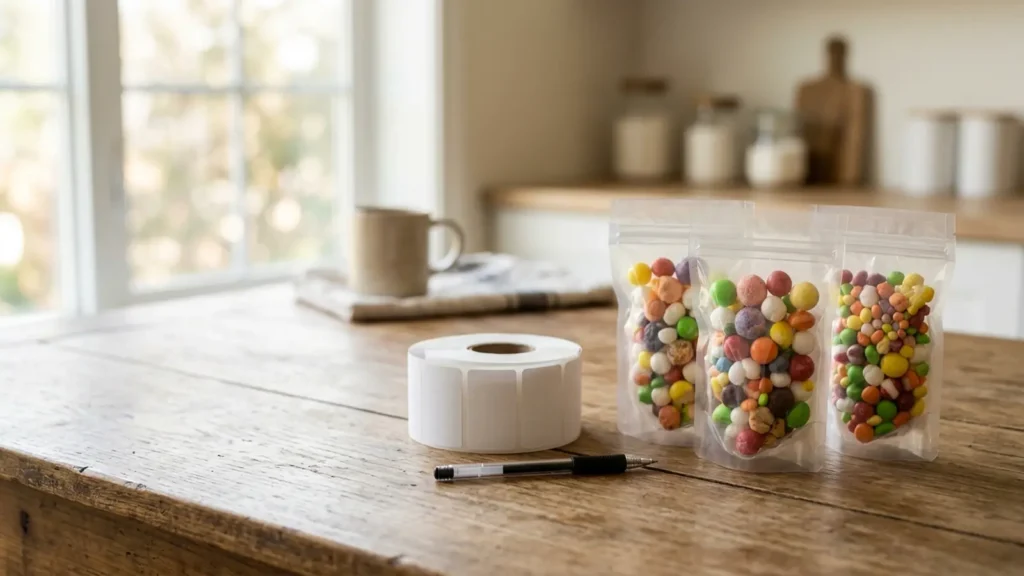
If you sell freeze-dried candy as a home food business, every bag needs a label. The required wording, type size and contact details differ by state. This page covers the four states in our selling freeze-dried candy guide. Whether you can sell at all is a separate question, which that guide answers.
On this page
Side-by-side
| Michigan | Washington | Ohio | Pennsylvania | |
|---|---|---|---|---|
| Required statement | “Made in a home kitchen that has not been inspected by the Michigan Department of Agriculture & Rural Development” | “MADE IN A HOME KITCHEN THAT HAS NOT BEEN SUBJECT TO STANDARD INSPECTION CRITERIA” | “This product is home produced.” | None listed by PDA |
| Type size | At least the equivalent of 11-point (about 1/8 in.), in a contrasting color | 11-point type size requirement referenced (hand-printed labels must equal it) | Ten-point | — |
| Who you are | Name and physical address, or MSU Product Center registration number and phone | Business name and permit number; home address not required | Business name and address | Business name and address |
| Ingredients | Descending order by weight, with sub-ingredients | All ingredients and sub-ingredients | Descending order of predominance by weight | Descending order by weight |
| Amount | Net weight or volume, plus metric equivalent | Net weight or net volume | Net weight and volume | Net weight or volume |
| Allergens | Per federal labeling requirements | Per federal labeling requirements | Federal rules apply (see below) | Allergen declarations, if applicable |
| Source | MDARD | WSDA | ORC 3715.023 | PDA |
Michigan
MDARD’s labeling page lists (MDARD):
- Your name and physical address, or your MSU Product Center registration number and phone number.
- The product name.
- Ingredients in descending order by weight, including sub-ingredients.
- Net weight or net volume, which “must also include the metric equivalent.”
- Allergen labeling “as specified in federal labeling requirements.”
- The statement “Made in a home kitchen that has not been inspected by the Michigan Department of Agriculture & Rural Development,” in at least the equivalent of 11-point type, in a contrasting color. All capitals or upper and lower case are both acceptable.
Hand-printed labels are acceptable if they are “clearly legible, written with durable, permanent ink,” and large enough to meet the type-size requirement (MDARD).
Washington
WSDA requires “an accurate label of every product you plan to sell” to be submitted with your Cottage Food Permit application (WSDA). Labels must include:
- Your business name and permit number. Before you’re permitted, use a “Permit #:_____” placeholder.
- The product name.
- All ingredients and sub-ingredients.
- The net weight or net volume.
- Allergens per federal rules.
- The statement “MADE IN A HOME KITCHEN THAT HAS NOT BEEN SUBJECT TO STANDARD INSPECTION CRITERIA.”
The physical address of your home kitchen “is not required to be listed on your labeling.” Hand-printed labels must equal the 11-point type requirement. Only products on your permit may be sold, under the names they’re labeled with (WSDA).
Ohio
Ohio law requires cottage food labels to show (ORC 3715.023):
- The business name and address.
- The product name.
- Ingredients “in descending order of predominance by weight.”
- “The net weight and volume.” Ohio’s statute says “and,” where the other three states say “or.”
- The statement “This product is home produced.” in ten-point type.
Ohio’s cottage food rule also points to federal labeling regulations in 21 CFR 101 (OAC 901:3-20-02).
Packaging caution: Ohio’s rule says cottage food products “may not be packed using reduced oxygen packaging” (OAC 901:3-20-04). If you plan to seal bags with oxygen absorbers, ask the Ohio Department of Agriculture whether that counts as reduced oxygen packaging before you label and sell. See the Ohio section of our selling guide.
Pennsylvania
Pennsylvania home processors register as a Limited Food Establishment. PDA says all products must have labels that include the product name, ingredients in descending order by weight, net weight or volume, your business name and address, and allergen declarations if applicable (PDA). Penn State Extension adds that the ingredients list should include sub-ingredients (Penn State Extension).
Writing the ingredient list for freeze-dried candy
Freeze-drying doesn’t add ingredients, so your list is the candy’s own list. If you use a store-bought candy, Michigan and Washington want its sub-ingredients spelled out (MDARD; WSDA). WSDA gives an example: “soy sauce” alone is not acceptable, but “soy sauce (wheat, soybeans, salt)” is. WSDA also reminds sellers that “different ingredient brands may contain different ingredients,” so update the label if you switch brands.
Weighing for the net weight
Weigh the sealed contents, not the bag, using a kitchen scale. Michigan also wants the metric equivalent alongside (MDARD).
Shop kitchen scales on Amazon →
Checklist before you print
- Confirm your state allows the product (see the selling guide).
- Use your state’s exact required statement and minimum type size.
- List all ingredients, and sub-ingredients where required, by weight.
- Declare allergens.
- Show net weight (and volume, in Ohio), plus metric in Michigan.
- Add your name and address, or your permit or registration details where your state allows them.
- In Washington, submit each label with your application.
Sources (checked October 13, 2026)
- MDARD: Cottage Food Labeling: https://www.michigan.gov/mdard/food-dairy/cottage-food/labeling
- WSDA: Cottage Food (labeling FAQ): https://agr.wa.gov/departments/food-safety/food-safety/cottage-food
- Ohio Revised Code 3715.023 (cottage food labels): https://codes.ohio.gov/ohio-revised-code/section-3715.023
- Ohio Administrative Code 901:3-20-02: https://codes.ohio.gov/ohio-administrative-code/rule-901:3-20-02
- Ohio Administrative Code 901:3-20-04 (reduced oxygen packaging): https://codes.ohio.gov/ohio-administrative-code/rule-901:3-20-04
- Pennsylvania Department of Agriculture: Limited Food Establishment: https://www.pa.gov/agencies/pda/food/food-safety/limited-food-establishment-
- Penn State Extension: Home-Style Kitchen Food Processing: https://extension.psu.edu/food-for-profit-home-style-kitchen-food-processing-limited-food-establishments