Quick answer
Keep the doors shut. A closed fridge keeps food safe for about 4 hours, and a full freezer holds about 48 hours.
- Fridge: 4 hoursThen toss meat, dairy, eggs and leftovers
- Full freezer: 48 hoursAbout 24 hours if it’s half full
- Refreeze if still icyOr if it’s still 40°F or below
- Never taste-testWhen in doubt, throw it out
This page may contain affiliate links. If you buy through them, we may earn a commission at no extra cost to you. Read our affiliate disclosure.
These times come from USDA FSIS and FoodSafety.gov. Here’s how to use them.
On this page
Right after the power goes out
The first hour is about keeping the cold in.
- Keep the doors closed. FSIS says to keep them shut, and FoodSafety.gov’s times assume the doors stay closed.
- Past 4 hours, use a cooler. FSIS says to move fridge food to a cooler with ice or frozen gel packs. Keep it at 40°F or below, and add ice as it melts.
- For a long outage, get ice. FSIS suggests dry ice or block ice. It says 50 pounds of dry ice should hold an 18-cubic-foot freezer for 2 days.
- Don’t use the snow. FSIS says not to put food outside in the snow. Fill containers with water and let them freeze outside, then use that ice.
Small, thin packages and food in the door or front of the freezer thaw first, FSIS says. Big items in the back stay frozen longest.
Fridge food: keep or toss
FSIS and FoodSafety.gov say to toss perishable fridge food after 4 hours without power. Check each item.
| Food | After 4 hours without power |
|---|---|
| Meat, poultry, fish, eggs | Toss |
| Leftovers, soups, pizza | Toss |
| Milk, cream, yogurt | Toss |
| Soft and shredded cheese | Toss |
| Cut fruit and vegetables | Toss |
| Hard and processed cheese | Keep |
| Butter and margarine | Keep |
| Whole fruit and vegetables | Keep |
| Bread, rolls, muffins | Keep |
| Mustard, ketchup, pickles, jam | Keep |
More from the FSIS and FoodSafety.gov lists
- Also toss: lunch meat and hot dogs, mixed salads, gravy and stuffing, opened juices, creamy dressings, batters and doughs, cream pies and pastries, and garlic in oil.
- Mayonnaise: toss opened mayonnaise, tartar sauce and horseradish if they sat above 50°F for over 8 hours.
- Cross-contamination: toss foods like bread or greens if raw meat juices dripped on them.
- Anything odd: FSIS says to toss any food with an unusual odor, color or texture.
Freezer food: refreeze or toss
FoodSafety.gov says thawed food can be refrozen if it still has ice crystals or is at 40°F or below. Quality may suffer.
| Freezer food | Still icy or 40°F or below | Above 40°F for 2+ hours |
|---|---|---|
| Meat, poultry, seafood | Refreeze | Toss |
| Frozen meals, pizza | Refreeze | Toss |
| Ice cream | Toss | Toss |
| Bread, plain cakes | Refreeze | Refreeze |
| Flour, nuts | Refreeze | Refreeze |
Check a few items with a food thermometer before you decide. Shop instant read thermometer on Amazon →
If your freezer quit on its own, the same checks apply: ice crystals, or 40°F or below.
Freeze-dried and shelf-stable food
This is the food an outage doesn’t touch.
- No fridge needed. FSIS says shelf-stable foods can be stored safely at room temperature. It lists canned goods, rice, pasta, flour and jerky, among others.
- Freeze-dried counts. FSIS says freeze-dried foods are shelf stable, as long as they’re in moisture-proof, airtight containers.
- It needs water. FSIS says freeze-dried food has to be rehydrated with water. Plan for that if your water depends on power.
- Watch the labels. FSIS says some canned foods, such as some hams and seafood, say “Keep Refrigerated.” Those aren’t shelf stable.
Store-bought freeze-dried meals work the same way: sealed pouches that need only water.
More on that: how to store freeze-dried food, how long it lasts and how to rehydrate it.
Mid-batch in a freeze dryer when the power went out? See freeze dryers and power outages.
Before the next outage
A few small habits buy you hours.
FSIS suggests:
- Keep appliance thermometers in the fridge and freezer. The fridge should be 40°F or below, the freezer 0°F or below.
- Group foods together so they stay cold longer.
- Fill freezer gaps with frozen water jugs, ice or gel packs.
- Freeze leftovers, milk and meat you won’t need right away.
- Keep a large cooler and frozen gel packs on hand.
- Find out where to buy dry ice and block ice nearby.
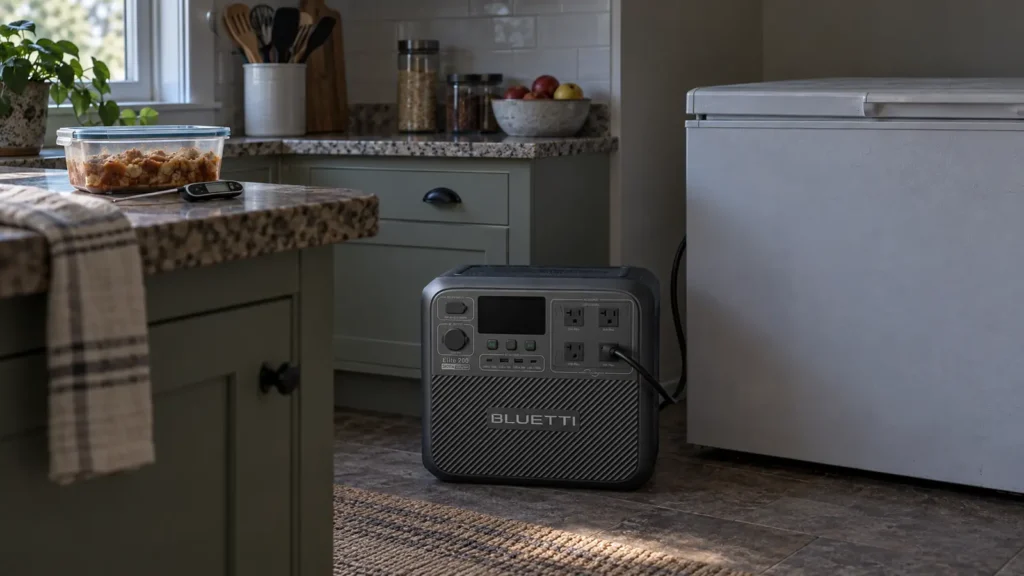
Planning to keep the fridge running on a generator or power station? Follow the maker’s instructions and CDC’s generator safety advice. One power-station option is the BLUETTI Elite 200 V2 (2,073.6 Wh capacity, 2,600 W continuous AC output with 3,900 W Power Lifting mode; BLUETTI’s site notes orders placed on or after Nov. 18 are expected to ship in early January).
Cleaning up after
If something spoiled, FSIS suggests:
- Throw out the spoiled food.
- Wash shelves, drawers and ice trays with hot water and detergent.
- Rinse with 1 tablespoon of unscented liquid bleach per gallon of water.
- Wash the inside with hot water and baking soda, then sanitize.
- Leave the door open for about 15 minutes.
FSIS says a fridge or freezer that sat in floodwater, even partly, must be thrown out.
FAQ
Quick answers to what people ask after the lights come back on.
How long is food safe in the fridge without power?
Up to 4 hours with the door kept closed, FSIS says. After that, toss perishables like meat, dairy, eggs and leftovers.
How long does a freezer stay cold without power?
About 48 hours if it’s full, or 24 hours if it’s half full, with the door closed.
Can I refreeze food that thawed?
Yes, if it still has ice crystals or is at 40°F or below, FoodSafety.gov says. Quality may suffer.
Can I tell by smelling or tasting it?
No. FSIS says never taste food to judge its safety. When in doubt, throw it out.
Is freeze-dried food safe after a power outage?
Yes, if it stayed sealed and dry. FSIS says freeze-dried foods are shelf stable in moisture-proof, airtight packaging.
Sources
- USDA FSIS, Keep Your Food Safe During Emergencies: Power Outages, Floods & Fires (fridge and freezer times, coolers, dry ice, keep or toss lists, cleaning; read Nov 21, 2026): https://www.fsis.usda.gov/food-safety/safe-food-handling-and-preparation/emergencies/keep-your-food-safe-during-emergencies
- FoodSafety.gov, Food Safety During Power Outage (fridge and freezer charts, refreezing; read Nov 21, 2026): https://www.foodsafety.gov/food-safety-charts/food-safety-during-power-outage
- USDA FSIS, Shelf-Stable Food Safety (shelf-stable and freeze-dried foods; read Nov 21, 2026): https://www.fsis.usda.gov/food-safety/safe-food-handling-and-preparation/food-safety-basics/shelf-stable-food
- CDC, What to Do to Protect Yourself During a Power Outage (generator placement; read Nov 21, 2026): https://www.cdc.gov/natural-disasters/response/what-to-do-protect-yourself-during-a-power-outage.html
- BLUETTI – Elite 200 V2 Portable Power Station (2,073.6 Wh, 2,600 W continuous, 3,900 W Power Lifting, ship window; read Nov 23, 2026): https://www.bluettipower.com/products/elite-200-v2-portable-power-station